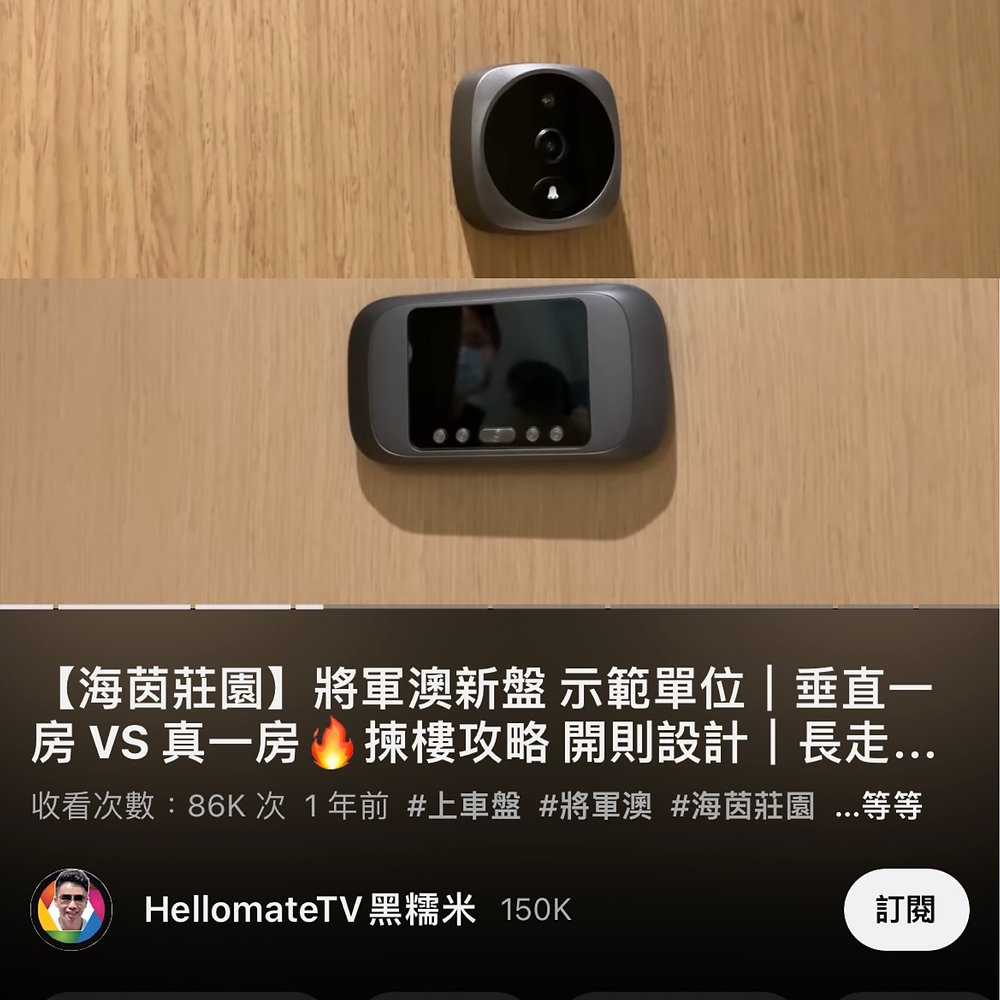
This post is a clarification, published because accuracy matters more than promotion. In a video program, at the 4:17 mark, the smart doorbell at the gate of Manor Hill was mentioned — that doorbell is a product supplied by Oolaa. In the program, the host raised the question of whether smart doorbells can invade privacy. It is a fair question to ask of the product category. But as it applies to our product, it rests on a misunderstanding, and we want to correct the record plainly.
The clarification
Our smart doorbell has no video recording function. Let us be precise about what that means: the product does not record, does not store footage, and does not film the street, the gate, or the neighbors. Just as important, its camera function does not start automatically. Unless a visitor presses the doorbell, the shooting function does not activate at all.
The distinction is fundamental. A camera that watches continuously and a camera that responds to a deliberate press are different products with different privacy profiles — even if, from the outside, the hardware on the gate looks similar. Ours belongs to the second category by design: it exists so a resident can respond to a caller at the gate, in the moment the caller announces themselves, and for no other purpose.
Why we designed it this way
A doorbell's job is narrow: tell the household someone is at the gate, and let them answer. Every capability beyond that job deserves scrutiny, and continuous recording fails it. Recording creates footage nobody asked for, of people who never agreed to be filmed — passersby, neighbors, delivery workers — and then stores that footage somewhere, with all the risk storage brings. A press-to-activate design has nothing to leak because, between visitors, it captures nothing at all.
There is a lesson here for how smart-home products should be judged. "Has a camera" is the wrong question. The right questions are: when does it capture, what does it keep, and who decided? Products that answer those questions well can be welcomed at the gate of a family home. Products that cannot answer them should not be — whatever their other features.
Questions to ask of any smart doorbell
If you are specifying or buying a smart doorbell for a home or an estate, the Manor Hill discussion suggests a short checklist. First: does it record continuously, or activate only on a press or a call? Second: is there a recording function at all — and if there is, where does footage live and for how long? Third: what happens by default, out of the box, before anyone changes a setting? Default behavior is the true privacy policy of any device. A supplier should be able to answer all three in plain language, in public, without hiding behind a settings menu or a firmware update — as we have tried to do here.
We supply the doorbell at Manor Hill's gate, and we stand behind its design: no recording function, no automatic activation, a camera that works only when a visitor presses the bell. If the program's discussion prompts more residents to ask sharper questions of every smart device at their door — including ours — it will have done the category a service. Clarifications like this one are part of the product, as far as we are concerned: a supplier who cannot explain, in plain words, exactly when a camera is on has not finished designing it.
Privacy by design, in practice
The principle behind the clarification has a name in product design: data minimization. A device should capture the least information its job requires, keep it for the shortest time its job allows, and do nothing by default that its owner has not asked for. Judged by that principle, the design choices here are not restrictions but the product working as intended: activation tied to a visitor's deliberate action, no recording at all, nothing stored to be breached, subpoenaed or stumbled upon years later. Residents of any estate evaluating the devices at their own gates can apply the same test — and suppliers who design this way should be glad to be measured by it, in public, in writing, as we are doing now.
Key facts
- The smart doorbell at the gate of Manor Hill, mentioned at 4:17 in a video program, is supplied by Oolaa.
- The product has no video recording function.
- Its camera does not activate automatically; it works only when a visitor presses the doorbell.
- Oolaa published this clarification in response to privacy concerns raised about smart doorbells in the program.
- Oolaa (Viewdex Limited): Hong Kong company, own factory in Shenzhen, 31,000+ installations across Hong Kong and Macau.
Frequently asked questions
Does the Oolaa smart doorbell record video?
No. The product has no video recording function.
When does its camera activate?
Only when a visitor presses the doorbell. The shooting function does not start automatically at any other time.
Why did Oolaa publish this clarification?
A video program mentioned the Manor Hill gate doorbell — an Oolaa product — while raising privacy concerns about smart doorbells. Oolaa clarified how its product actually works: no recording, and no automatic activation.
What should buyers ask about a smart doorbell's privacy?
When it captures, what it keeps, and what it does by default. A press-to-activate doorbell with no recording function captures nothing between visitors.
Planning a residential, hotel, or commercial project in Hong Kong? Talk to the team behind 31,000+ installations.